Love this? Save it for later!
Share the inspiration with your friends
October’s first chill crept through the kitchen window, and I found myself staring at a carton of eggs, wondering how to make them feel a little more sinister. The kids were already buzzing about costumes and candy, but I wanted something that would make them stop, lean in close, and maybe even shiver a little before laughing. That’s when the black olives caught my eye from the pantry shelf—small, dark, and perfect for transformation.
It wasn’t a planned recipe, honestly. I had a batch of hard-boiled eggs cooling on the counter for a quick lunch, and the idea just hit me. What if those little olive discs could become spider bodies? What if the deviled eggs themselves looked like creepy little ghosts? I grabbed a knife and started slicing, and by the time the filling was piped and the spiders were perched on top, I knew I had stumbled onto something special. My daughter called them “spooky snacks” and refused to eat one until she’d arranged them on the platter herself.
These Spooky Halloween Deviled Eggs with Black Olive Spiders aren’t just cute—they’re the kind of recipe that makes people stop and take a second look. The creamy, tangy filling contrasts perfectly with the briny olives, and the whole thing comes together in about thirty minutes. No fancy equipment, no weird ingredients, just classic deviled eggs with a Halloween twist that actually works. I’ve made them for three Halloweens in a row now, and they disappear faster than candy corn every single time.
Why You’ll Love This Recipe
Let me tell you why these deviled eggs have become my go-to Halloween appetizer. First off, they’re ridiculously easy. I’m talking about a recipe that uses basic ingredients you probably already have in your fridge. The only special purchase is black olives, and honestly, you might have those too.
- Quick & Easy: From start to finish, you’re looking at about 30 minutes of active work. The eggs boil while you prep everything else, and assembly takes maybe ten minutes total. Perfect for those last-minute Halloween party invites.
- Simple Ingredients: Eggs, mayo, mustard, paprika, salt, pepper, and black olives. That’s it. No trips to specialty stores, no hunting down weird garnishes.
- Perfect for Halloween Parties: These things are conversation starters. People see the spider on top and immediately want to know how you did it. Kids love them, adults love them, and they fit right in with any spooky spread.
- Crowd-Pleaser: I’ve brought these to potlucks, office parties, and family gatherings. They’re always the first thing to disappear. There’s something about the combination of creamy filling and briny olive that just works.
- Unbelievably Delicious: This isn’t just a gimmick recipe. The deviled egg filling is perfectly seasoned—tangy from the mustard, rich from the yolks, with just a hint of smokiness from the paprika. The olive spider adds a savory pop that balances everything out.
What makes this recipe different from other Halloween deviled eggs I’ve seen online is the attention to detail. I’ve tested different olive sizes, different leg placements, and different piping techniques to make sure the spiders actually look like spiders and not just olives on eggs. The legs are cut just right so they curl naturally, and the body sits perfectly in the center of the filling. It’s those little things that make people say “wow” instead of just “oh, that’s cute.”
Honestly, this recipe makes me happy every time I make it. There’s something satisfying about creating something that looks genuinely spooky but tastes like comfort food. It’s the kind of recipe that makes you feel clever without actually trying that hard.
What Ingredients You Will Need
This recipe uses simple, everyday ingredients to create something that looks like it came from a haunted kitchen. Here’s what you’ll need and why each ingredient matters.
For the Deviled Eggs
- 6 large eggs (room temperature works best for even cooking, but cold is fine too)
- 3 tablespoons mayonnaise (I prefer Duke’s or Hellmann’s for that tangy, creamy texture)
- 1 teaspoon yellow mustard (adds that classic deviled egg tang—Dijon works too if you want a sharper flavor)
- 1/2 teaspoon white vinegar (helps brighten the filling and cut through the richness)
- 1/4 teaspoon salt (adjust to taste—I find this is usually perfect)
- 1/8 teaspoon black pepper (freshly ground gives the best flavor)
- 1/4 teaspoon paprika (for garnish and a subtle smoky flavor—smoked paprika is amazing here)
For the Black Olive Spiders
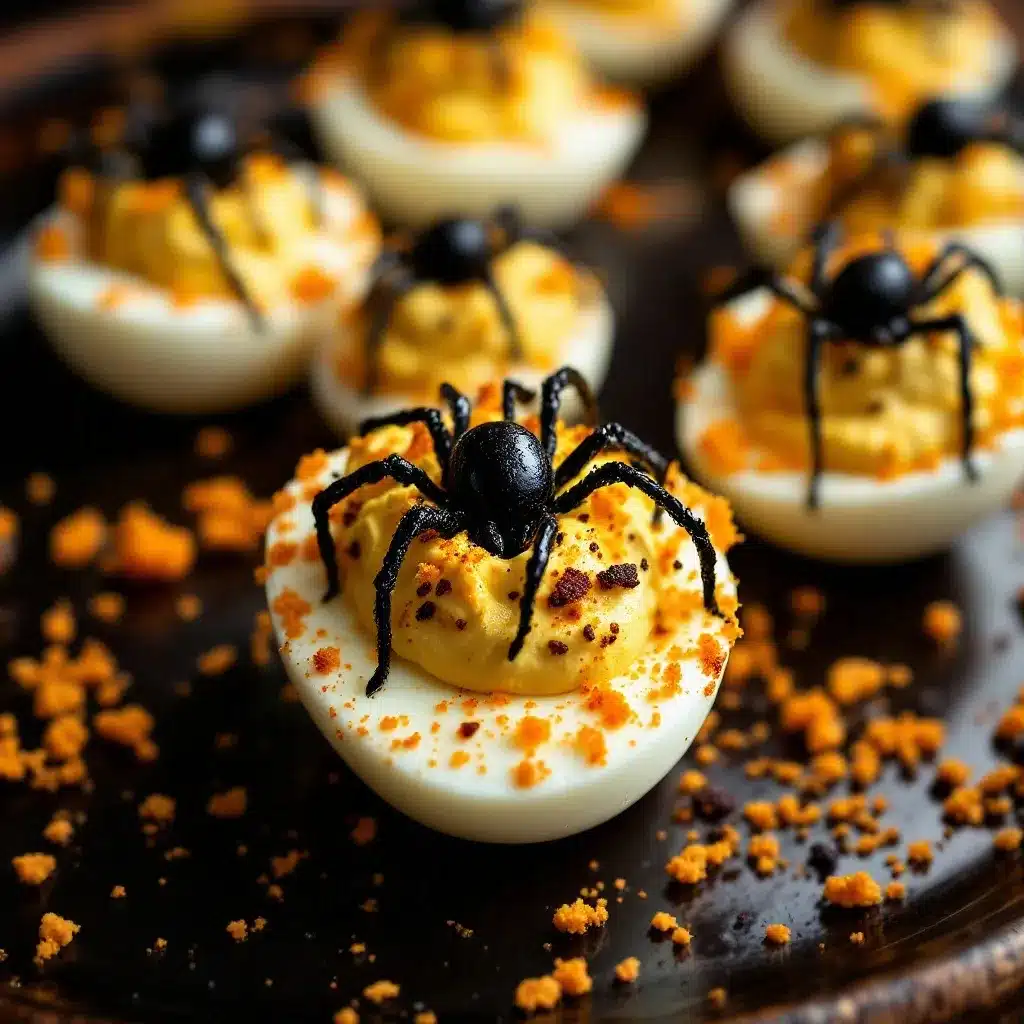
- 12 whole black olives (canned or jarred, pitted—look for large, firm olives for easier slicing)
- 6 small black olive slices (for the spider heads—these come from the same can)
The eggs are obviously the star here. I recommend using eggs that are at least a week old for easier peeling. Fresh eggs are notorious for sticking to the shell, and nobody wants to wrestle with that when you’re trying to make something pretty. If you only have fresh eggs, add a teaspoon of baking soda to the boiling water—it helps loosen the shells.
For the mayonnaise, I’ve tried several brands, and Duke’s really does make a difference. It’s tangier than most, which balances the richness of the yolks perfectly. But honestly, any full-fat mayo works. Avoid the low-fat stuff—it tends to be watery and won’t give you that creamy, stable filling.
The black olives are where the magic happens. Look for whole, pitted olives that are firm and not too mushy. I’ve found that Lindsay or California Ripe brands work well because they hold their shape when sliced. Avoid the sliced olives in a can—they’re too thin and won’t give you the right look for the spider legs.
Paprika is more than just garnish here. It adds a subtle earthiness that complements the eggs and olives. Smoked paprika takes it to another level—it gives the eggs a slightly campfire-y flavor that’s perfect for Halloween. Just don’t use too much, or it’ll overpower everything.
Equipment Needed
You don’t need much for this recipe, which is part of why I love it. Here’s what you’ll need:
- Medium saucepan (for boiling the eggs—any size works as long as the eggs fit in a single layer)
- Sharp paring knife (for slicing olives and cutting the spider legs—a dull knife will crush the olives)
- Cutting board (preferably small, so you have control over your cuts)
- Small mixing bowl (for mashing the yolks and mixing the filling)
- Fork or potato masher (for breaking up the yolks—a fork works fine, but a masher is faster)
- Piping bag or zip-top bag (for filling the eggs—a zip-top bag with the corner snipped off works perfectly)
- Large star tip (optional, but gives the filling that classic ruffled look)
- Serving platter (something with a bit of depth to hold the eggs steady)
If you don’t have a piping bag, don’t worry. A zip-top bag works just as well. Just spoon the filling into the bag, squeeze out the air, and snip off about half an inch from one corner. You can pipe directly from there, and it’ll look almost as good as with a star tip.
I’ve made these eggs in kitchens with nothing but a saucepan and a fork, and they turned out great. The only non-negotiable tool is a sharp knife for the olives. Seriously, a dull knife will turn your spider legs into mushy blobs, and that’s not the look we’re going for.
Preparation Method
Let me walk you through this step by step. I’ve made these eggs so many times that I’ve got the process down to a science.
- Boil the eggs. Place the eggs in a single layer in your saucepan and cover them with cold water by about an inch. Bring the water to a rolling boil over high heat. Once it’s boiling, cover the pot, remove it from the heat, and let it sit for exactly 10 minutes. This gives you perfectly hard-boiled eggs with firm yolks and no green ring around the edge. While the eggs are sitting, fill a bowl with ice water.
- Cool the eggs. After 10 minutes, transfer the eggs to the ice water bath using a slotted spoon. Let them sit for at least 5 minutes. This stops the cooking process and makes them easier to peel. I’ve learned the hard way that skipping this step leads to eggs that are overcooked and rubbery.
- Peel the eggs. Gently tap each egg on the counter to crack the shell, then roll it between your palms to loosen the shell. Start peeling from the wider end—there’s usually an air pocket there that makes it easier. Rinse the peeled eggs under cold water to remove any tiny shell fragments. Pat them dry with a paper towel.
- Slice the eggs in half. Using a sharp knife, slice each egg lengthwise. Wipe the knife clean between cuts to keep the edges neat. Carefully pop out the yolks into your mixing bowl. Set the egg white halves aside on your serving platter.
- Make the filling. Mash the yolks with a fork until they’re fine crumbs with no large chunks. Add the mayonnaise, mustard, vinegar, salt, and pepper. Mix until everything is smooth and creamy. Taste it and adjust the seasoning—I usually add a pinch more salt and a dash more mustard. The filling should be tangy, creamy, and just a little bit rich.
- Pipe the filling. Spoon the filling into your piping bag or zip-top bag. If you’re using a star tip, attach it now. Pipe the filling into each egg white half, dividing it evenly. I like to pipe in a circular motion starting from the outside and working inward, which gives a nice ruffled look. You should have enough filling for all 12 halves.
- Make the spider bodies. Take your whole black olives and slice them in half lengthwise. You’ll get two oval pieces from each olive. Set these aside—they’ll be the spider bodies.
- Make the spider legs. Take the remaining olive halves (the ones you didn’t use for bodies) and slice each one into thin strips lengthwise. Each olive half should give you about 4-5 strips. These are your spider legs. You’ll need 8 legs per spider, so plan accordingly.
- Make the spider heads. Slice the small olive crosswise into thin rounds. Each round will be a spider head. You’ll need one head per spider.
- Assemble the spiders. Place one spider body (the oval olive half) in the center of each deviled egg filling. Arrange 8 spider legs around each body—4 on each side—pushing them gently into the filling so they stay in place. Place one olive round at the top of each body for the head. The legs should curl slightly from the slicing, which gives them a natural, creepy look.
- Garnish and serve. Lightly sprinkle paprika over the entire platter, focusing on the eggs themselves. The paprika adds color and a bit of smoky flavor. Serve immediately or refrigerate until ready.
A few notes from experience: The spider legs will look more realistic if you let them curl naturally. Don’t try to straighten them out. Also, if you’re making these ahead of time, wait to add the spiders until just before serving. The olives can make the filling a bit watery if they sit too long.
Cooking Tips & Techniques
I’ve made my share of mistakes with these eggs, so let me save you some trouble. Here’s what I’ve learned over the years.
Perfect hard-boiled eggs every time: The key is the 10-minute rest after boiling. Don’t skip it. If you boil the eggs for 12 minutes, the yolks will turn gray and chalky. If you boil them for 8, they’ll be soft. Ten minutes is the sweet spot. And please, please, please use the ice bath. I once skipped it because I was in a hurry, and I spent 20 minutes peeling eggs that looked like they’d been through a war.
Easy peeling trick: Add a teaspoon of baking soda to the water before boiling. It raises the pH of the water, which helps loosen the eggshells. Also, older eggs peel more easily than fresh ones. If you’re planning ahead, buy your eggs a week before you need them.
Olive slicing technique: Use a sharp knife and slice slowly. Olives are slippery little things, and they’ll shoot across the cutting board if you’re not careful. I hold the olive steady with my fingertips curled under, like a claw, and slice away from my hand. It feels safer and gives me more control.
Filling consistency: The filling should be creamy but not runny. If it’s too thick, add a tiny splash of milk or pickle juice. If it’s too thin, add another yolk or a bit more mayo. You want it to hold its shape when piped, not spread out into a puddle.
Timing strategy: I boil the eggs first, then prep the olives while they’re cooling. That way, by the time the eggs are peeled and halved, the olives are ready to go. It saves about 10 minutes and keeps the workflow smooth.
Common mistake to avoid: Don’t overfill the piping bag. I did this once and ended up with filling squirting out the top and all over my hands. Fill the bag about halfway, twist the top closed, and pipe from there. You can always refill if you need more.
Variations & Adaptations
These deviled eggs are pretty flexible, and I’ve tried a few different versions over the years. Here are some ideas if you want to mix things up.
Spicy Version: Add a dash of cayenne pepper or a few drops of hot sauce to the filling. The heat pairs surprisingly well with the briny olives. I made these for a Halloween party last year, and they were a hit with the adults. Just go easy—you want a kick, not a fire alarm.
Avocado Deviled Eggs: Replace half the mayonnaise with mashed avocado. It makes the filling greener and creamier, with a slightly different flavor. The green color actually looks pretty spooky against the black olives, so it’s a win-win. Just add a squeeze of lemon juice to keep the avocado from browning.
Smoky Paprika Version: Use smoked paprika instead of regular paprika in the filling and as garnish. It gives the eggs a deeper, more complex flavor that feels perfect for fall. I’ve also tried adding a pinch of chipotle powder for extra smokiness, and it was fantastic.
Gluten-Free Adaptation: This recipe is naturally gluten-free, so no changes needed. Just double-check your mustard and mayonnaise labels if you’re serving someone with celiac disease—some brands add gluten-containing ingredients.
Dairy-Free Version: Use a vegan mayonnaise or make your own with aquafaba. The filling will be slightly different in texture, but it still works well. Just make sure your mustard is dairy-free too.
Different Spider Designs: If black olives aren’t your thing, try using sliced black beans for the spider bodies or even small pieces of roasted red pepper. I’ve also seen people use capers for the spider heads, which gives a similar look with a different flavor profile.
Colorful Variations: Add a drop of food coloring to the filling for a Halloween twist. Green or orange filling looks especially festive. Just be careful not to add too much—you want the color to be subtle, not neon.
Serving & Storage Suggestions
These deviled eggs are best served cold or at room temperature, so they’re perfect for parties where food sits out for a while. Here’s how I like to serve them.
Serving temperature: Take the eggs out of the fridge about 15 minutes before serving. They taste better when they’re not ice-cold, and the flavors are more pronounced at room temperature. If you’re serving them at a party, arrange them on a platter and let them sit while guests arrive.
Presentation ideas: Arrange the eggs on a black or dark-colored platter for maximum spooky effect. I like to garnish the platter with a few whole olives, some fresh parsley or dill, and a light dusting of paprika. If you’re feeling extra festive, add some fake spider webs or plastic spiders around the edges. Just make sure guests know which spiders are real and which are fake—I learned that one the hard way.
Complementary dishes: These eggs pair beautifully with other Halloween appetizers. I often serve them alongside my Mummy Wrapped Baked Brie with Raspberry Jam for a complete spooky spread. They also work well with Crispy Baked Buffalo Cauliflower Bites for a game day Halloween party. For drinks, a Homemade Pumpkin Cream Cold Foam Coffee is the perfect non-alcoholic option.
Storage instructions: Store leftover deviled eggs in an airtight container in the refrigerator for up to 3 days. The filling may weep a little as it sits, so pat them dry with a paper towel before serving leftovers. The olive spiders will stay fresh for about 24 hours before they start to soften, so these are best eaten the day you make them.
Freezing: Don’t freeze these. The texture of the eggs and filling will be ruined. If you need to make them ahead, boil and peel the eggs up to 2 days in advance, then assemble the filling and spiders the day of serving.
Flavor development: The filling actually tastes better after it’s been refrigerated for a few hours. The flavors meld together and become more cohesive. I’ve made the filling a day ahead and piped it fresh the next day, and it was perfect.
Nutritional Information & Benefits
These deviled eggs are surprisingly nutritious for a party appetizer. Here’s the breakdown per serving (one deviled egg half with one spider):
- Calories: Approximately 80-90 calories
- Protein: 6 grams
- Fat: 6 grams (mostly healthy fats from the egg yolks and olive oil)
- Carbohydrates: 1 gram
- Fiber: 0.5 grams
- Sodium: 180-200 mg
Eggs are a fantastic source of high-quality protein and contain essential nutrients like vitamin D, vitamin B12, and choline, which supports brain health. The yolks are rich in antioxidants like lutein and zeaxanthin, which are good for eye health. Black olives provide healthy monounsaturated fats and a small amount of iron and vitamin E.
This recipe is naturally low-carb and keto-friendly, making it a great option for guests with dietary restrictions. It’s also gluten-free and can be made dairy-free with a simple mayonnaise swap. The only potential allergen is eggs, so make sure to label them clearly if you’re serving at a party where someone might have an egg allergy.
I personally love that these deviled eggs are a healthier option for Halloween parties. They’re satisfying without being heavy, and they don’t leave you feeling sluggish like some other party foods. Plus, the protein keeps you full longer, which means less mindless snacking on candy later.
Conclusion
These Spooky Halloween Deviled Eggs with Black Olive Spiders have become a tradition in my house, and I hope they become one in yours too. They’re easy enough for a weeknight Halloween dinner, impressive enough for a party, and fun enough to make the kids giggle. The combination of creamy, tangy filling and briny olive spiders is genuinely delicious—not just a gimmick.
I love how this recipe lets you be creative without stressing over complicated techniques. You can make the spiders as simple or as detailed as you want, and they’ll still look amazing. The first time I made these, my daughter said they were “the best Halloween food ever,” and honestly, that’s all the validation I needed.
If you try this recipe, I’d love to hear how it goes. Leave a comment below and let me know if your guests were spooked or delighted—or both. Share your photos on social media and tag me so I can see your spider creations. And if you come up with your own variation, definitely share that too. I’m always looking for new ideas to try.
Happy Halloween, and happy cooking. May your eggs be perfectly peeled, your spiders be properly spooky, and your party be full of delicious surprises.
Frequently Asked Questions
Can I make these deviled eggs ahead of time?
Yes, you can make them up to 2 days ahead of time. Boil and peel the eggs, prepare the filling, and store them separately in the refrigerator. Assemble the eggs and add the olive spiders just before serving for the best presentation.
Why are my deviled eggs hard to peel?
Fresh eggs are notoriously difficult to peel. Use eggs that are at least a week old for easiest peeling. Adding a teaspoon of baking soda to the boiling water also helps loosen the shells. And don’t skip the ice bath—it’s crucial for easy peeling.
Can I use different olives for the spiders?
Absolutely. Kalamata olives work well and have a slightly different flavor. Green olives with pimentos can also be used, though the color will be different. Just make sure the olives are firm enough to slice without falling apart.
How do I store leftover deviled eggs?
Store them in an airtight container in the refrigerator for up to 3 days. The filling may weep a little, so pat them dry before serving leftovers. The olive spiders will soften after 24 hours, so these are best eaten fresh.
Can I make these deviled eggs without mayonnaise?
Yes, you can substitute Greek yogurt or mashed avocado for the mayonnaise. The texture will be slightly different, but both options work well. Greek yogurt adds extra protein, while avocado gives a creamy, rich flavor.
Pin This Recipe!
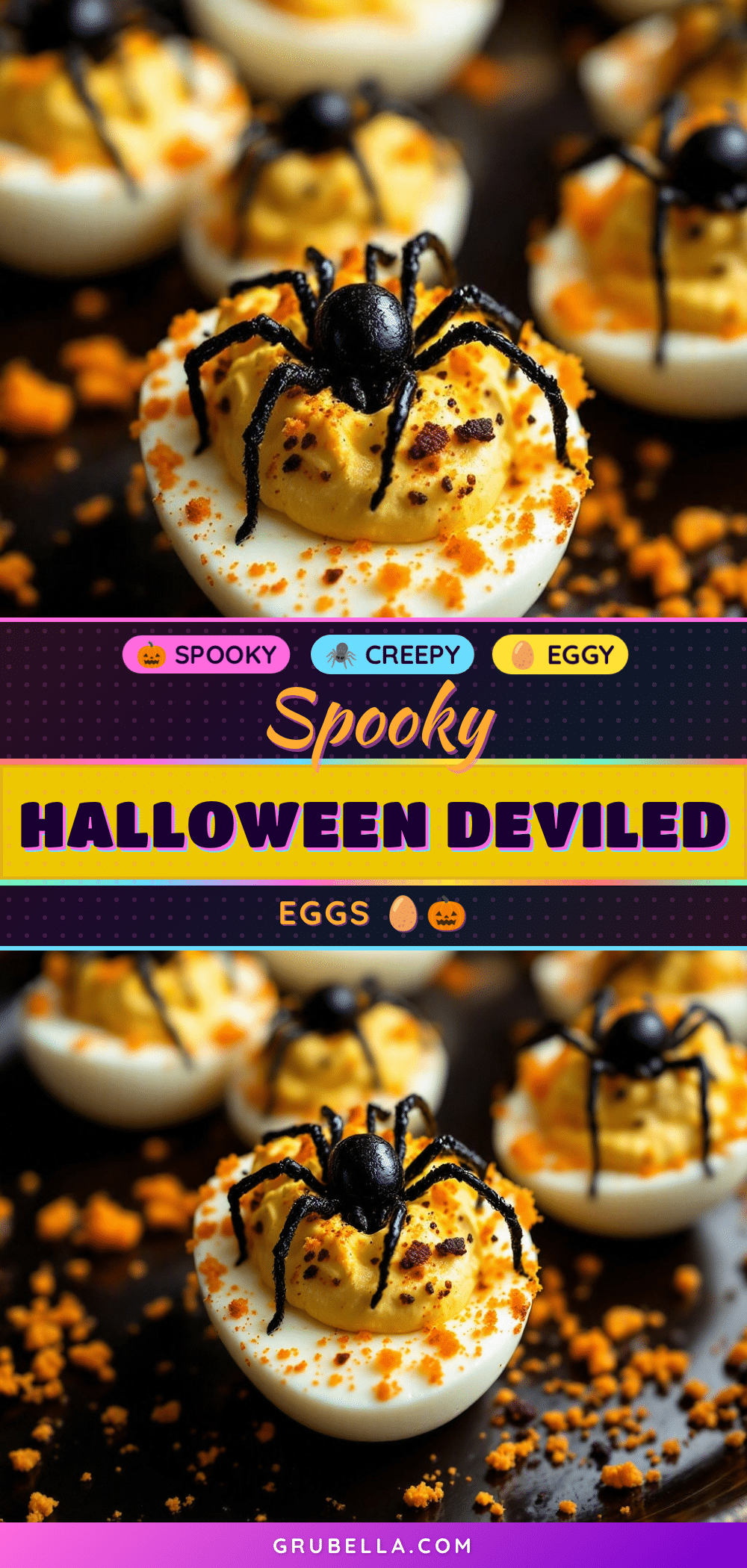
Best Easy Spooky Halloween Deviled Eggs Black Spider Recipe
These spooky deviled eggs feature a creamy, tangy filling topped with black olive spiders. They are quick to make, use simple ingredients, and are perfect for Halloween parties.
- Prep Time: 15 minutes
- Cook Time: 10 minutes
- Total Time: 30 minutes
- Yield: 12 deviled egg halves (6 servings of 2 halves each) 1x
- Category: Appetizer
- Cuisine: American
Ingredients
- 6 large eggs
- 3 tablespoons mayonnaise
- 1 teaspoon yellow mustard
- 1/2 teaspoon white vinegar
- 1/4 teaspoon salt
- 1/8 teaspoon black pepper
- 1/4 teaspoon paprika
- 12 whole black olives (pitted)
- 6 small black olive slices
Instructions
- Place eggs in a single layer in a saucepan and cover with cold water by about an inch. Bring to a rolling boil over high heat. Cover, remove from heat, and let sit for exactly 10 minutes.
- Transfer eggs to an ice water bath and let cool for at least 5 minutes.
- Peel the eggs, rinse under cold water, and pat dry.
- Slice each egg in half lengthwise. Remove yolks to a mixing bowl. Set egg white halves aside.
- Mash yolks with a fork until fine crumbs. Add mayonnaise, mustard, vinegar, salt, and pepper. Mix until smooth and creamy. Adjust seasoning to taste.
- Spoon filling into a piping bag or zip-top bag. Pipe filling into each egg white half, dividing evenly.
- Slice whole black olives in half lengthwise to make spider bodies. Set aside.
- Slice remaining olive halves into thin strips lengthwise (about 4-5 strips per half) for spider legs.
- Slice small olive crosswise into thin rounds for spider heads.
- Place one spider body (oval olive half) in the center of each deviled egg filling. Arrange 8 spider legs around each body (4 on each side), pushing gently into filling. Place one olive round at the top of each body for the head.
- Lightly sprinkle paprika over the platter. Serve immediately or refrigerate until ready.
Notes
Use eggs at least a week old for easier peeling. Add a teaspoon of baking soda to the boiling water to help loosen shells. For best presentation, add olive spiders just before serving. The filling tastes even better after refrigerating for a few hours.
Nutrition
- Serving Size: 2 deviled egg halves
- Calories: 8090
- Sugar: 0.5
- Sodium: 180200
- Fat: 6
- Saturated Fat: 1.5
- Carbohydrates: 1
- Fiber: 0.5
- Protein: 6
Keywords: Halloween deviled eggs, spooky deviled eggs, black olive spiders, Halloween appetizer, easy deviled eggs